A High-Impact Ad Strategy for Bloomberg Media
- ClientBloomberg
- IndustryMedia & Publishing
- CapabilitiesContent strategy · Analysis and Strategy · Brand Foundation · Opportunity Analysis · Audience insights · Current Site and Opportunity Analysis
Transforming Bloomberg's digital ad strategy
Bloomberg Media's high-impact ad strategy focuses on delivering engaging and effective advertising solutions that resonate with audiences. By leveraging data-driven insights and innovative formats, the strategy aims to enhance brand visibility and drive meaningful interactions. This approach not only maximizes ad performance but also aligns with the evolving needs of advertisers.
The strategy emphasizes collaboration with clients to create tailored campaigns that meet specific objectives. By integrating advanced targeting techniques and creative storytelling, Bloomberg Media ensures that ads capture attention and foster brand loyalty. Ultimately, this high-impact approach positions advertisers for success in a competitive landscape.
Key Takeaways
Enhanced ad engagement with innovative design.
Scalable platform for future adaptability.
Strengthened brand through strategic digital transformation.
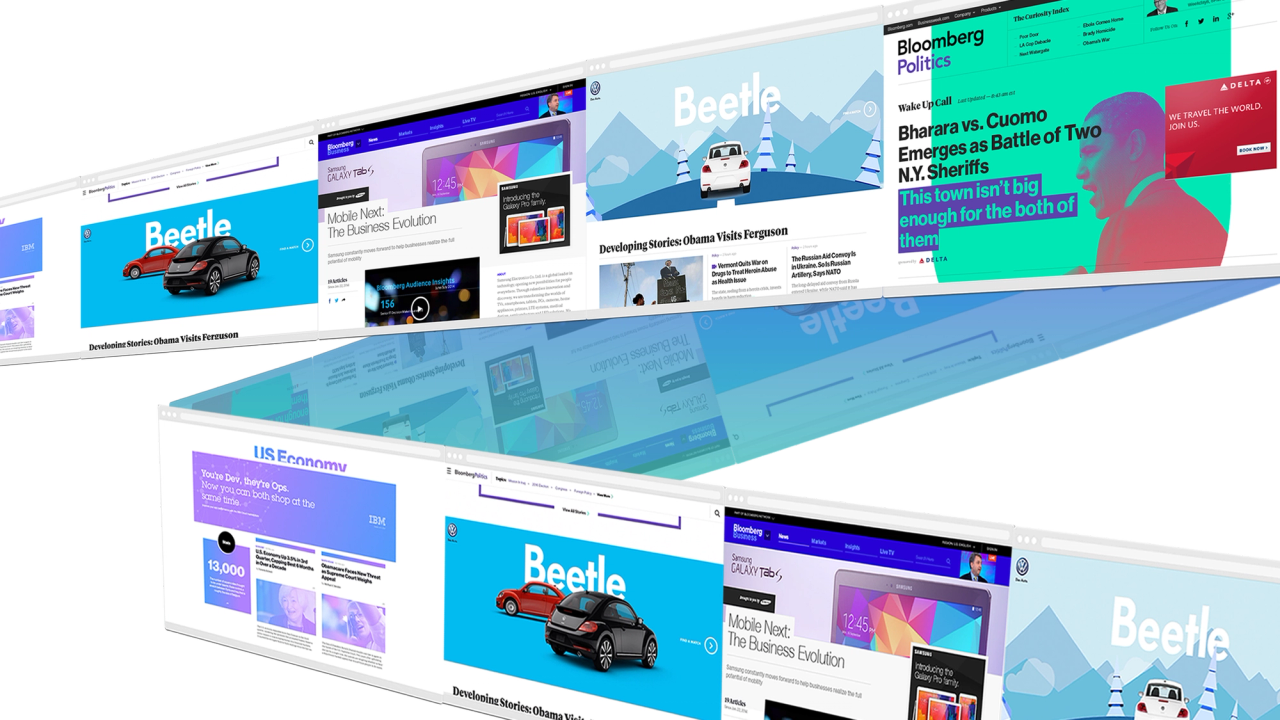
Working together, Bloomberg and Code and Theory turned that vision into reality.
The new ad strategy was three-pronged. The first component: a new suite of completely customizable interactive ad units that were as visually interesting and engaging as the editorial content itself. Second: an unobtrusive, beautiful new way for readers to experience standard IAB display ads as they scrolled through the site. And finally, a new modular design system that allowed for a variety of new custom content integrations and sponsored content.
It was an entirely new strategy and spectrum of offerings that didn’t only meet advertiser requirements—it exceeded expectations.

A digital-led media experience
The result—which debuted in October 2014 with the launch of Bloomberg Politics and carried through to the launch of the new Bloomberg.com in January 2015—was a sophisticated system that went beyond ad maps and page templates. It was a scalable, modular platform that could accommodate any current or future sites in the Bloomberg ecosystem.
From day one, Bloomberg and Code and Theory envisioned a beautiful, holistic reading experience for the new platform—one where both standard and premium ads were seamlessly woven into the editorial itself. We worked to create a system where ads were not designed and integrated as an afterthought but as an essential part of the aesthetic experience.
For years, users have trained themselves to divert their attention away from the right side of a web page.
To battle this “right rail blindness,” Code and Theory and Bloomberg considered the natural ways that users consume content online. They swipe, click, and increasingly use multi-touch gestures, with the scroll remaining paramount.
With a renewed emphasis on ad viewability—which has become the primary success metric for advertisers—Bloomberg challenged Code and Theory to drastically improve the chances that every ad on the new site was actually seen.
So, rather than attempt to catch the corner of a reader’s eye, the team made sure that each ad—even standard units—responded to user behaviors in surprising ways.
For example:
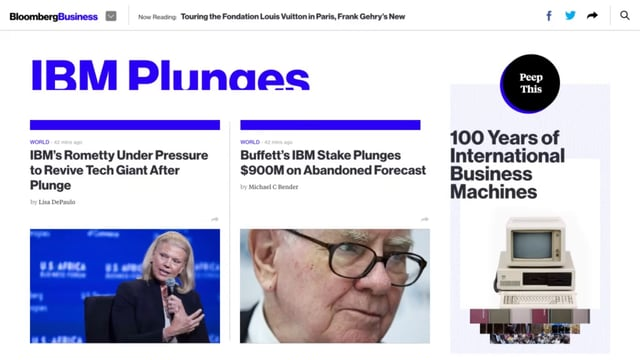
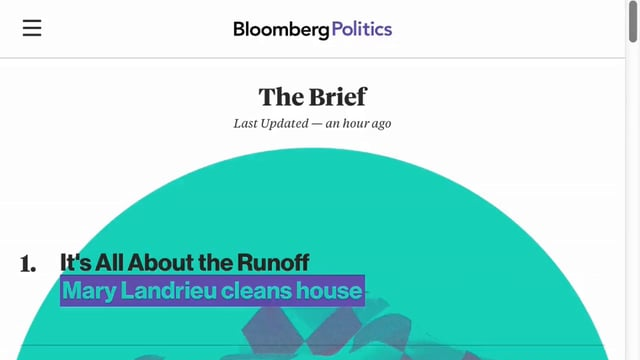
— 01
Reacting to the Scroll
Bloomberg’s new suite of customizable ad units was built on a framework where certain elements of an ad reacted to the user’s scroll. Elements would move up, down, left and right at different speeds, while other elements stayed fixed in place.
“There’s something interesting that happens when the user is involved in initiating the ad without realizing it,” says Christopher Hall, associate creative strategy director at Code and Theory.
Take, for instance, this BP ad. At first, the ad appears to be stationary, almost like you’re peering through a window. As the user scrolls, various elements within the ad—like the trucks and airplane—come to life.
— 02
Embracing the Scroll
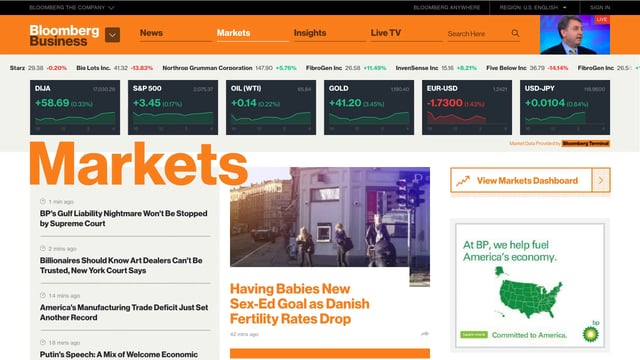
Another key strategy to increase ad viewability on Bloomberg.com was the concept of “locking” standard IAB ad placements. As a user moves down the page, standard display ads on the left and right of the page hold steady as the news headlines race by. By locking the ad inventory under the vertical header, the site increases viewability for each ad impression.
The effect for readers? The ad is pretty hard to miss.
— 01
Leveraging Visual Design Elements
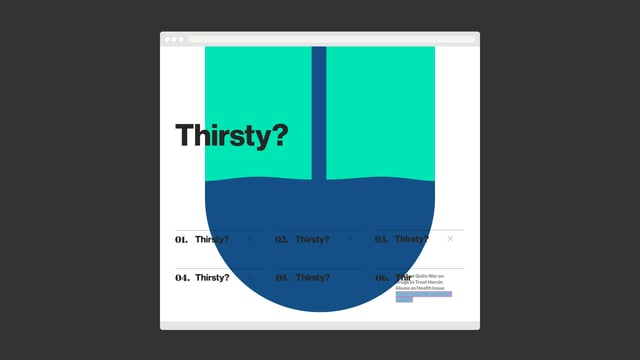
Here is an example of a custom ad execution leveraging the visual design elements of the grid that appears on each section front of bloomberg.com.
What We Did
Platform
Content
Customer Experience
Technology
Code and Theory’s vision for Bloomberg’s custom ad units was to create a modular design system.
The project for Bloomberg Media focused on developing a high-impact advertising strategy that effectively engaged their target audience. By leveraging data-driven insights and innovative ad formats, the strategy aimed to enhance brand visibility and drive user interaction. The value achieved included increased ad performance metrics, improved audience engagement rates, and a stronger overall brand presence in a competitive media landscape. This approach not only met Bloomberg Media's advertising goals but also set a benchmark for future campaigns.
Let’s get to work. Start a conversation.
newbiz@codeandtheory.comCode and Theory is a proud member of Stagwell Group. Stagwell is the challenger network built to transform marketing. We deliver scaled creative performance for the world’s most ambitious brands, connecting culture-moving creativity with leading-edge technology to harmonize the art and science of marketing. Led by entrepreneurs, our 13,000+ specialists in 34+ countries are unified under a single purpose: to drive effectiveness and improve business results for their clients. Join us at www.stagwellglobal.com
Decode
Keep up with the culture, one newsletter at a time. Subscribe to DECODE:
Find Us
One World Trade Center,
69th Floor
New York, NY 10007