Stop Guessing. Start Knowing: Moving Content Strategy Upstream
Every channel is always-on, and every customer expects something tailored, as they should. Demand and expectations keep rising, but how teams optimize content hasn't kept pace. We know this because insight still arrives after decisions are made, when it's too late to change anything.
It’s a familiar, if rigid, pattern. You know your customers. You have the data, build segments, develop profiles, layer in instinct and ship content you’re pretty sure will land.
When the results eventually come back, you’ll analyze and adjust. Maybe you’ll run an A/B test. It's labor-intensive, yielding incremental results. That’s because the process is entirely reactive: You're learning after the budget is spent and the opportunity is gone. Then the cycle begins anew, chasing marginal gains on the next go-round.
The cycle is due for a reset.
The traditional tools — focus groups, surveys, interviews, intuition — designed to close that gap don't. AI has mostly accelerated production, so teams can ship more content than ever. But more output is useless if it’s crafted without better foresight. The Creative Intelligence System (CIS) was built to close that gap.
Personas You Can Talk To
Personas are useful for alignment, but once defined, they just sit there — static profiles to be referenced. You can't ask them anything, nor pressure-test your thinking against them.
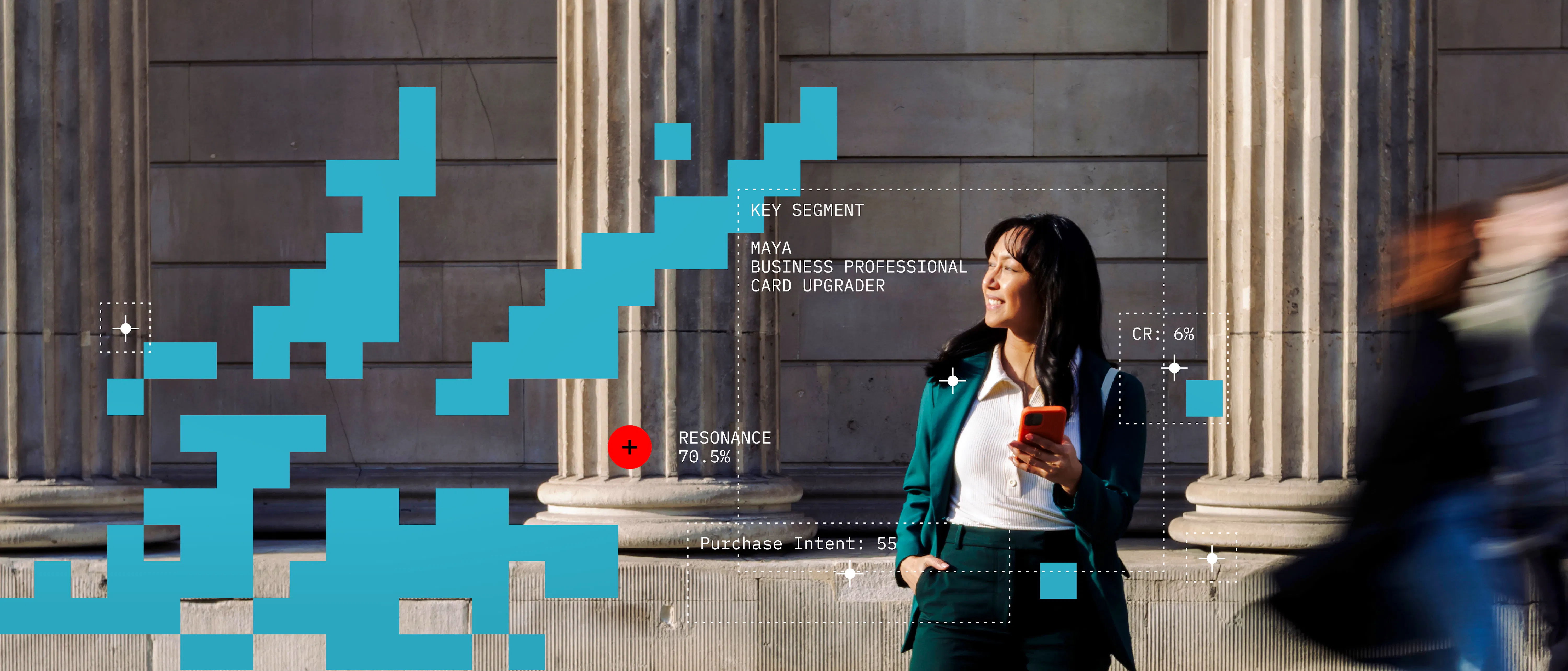
CIS solves this by synthesizing personas that talk back.
Synthetic personas are built from first-party data and grounded in platforms like Adobe Experience Platform, without that data leaving a secure environment. These are responsive models that can actually hold a conversation.
Before anything goes live, you can ask them:
- Will this resonate with this audience?
- How much and why?
- Where will they push back?
Synthetic personas can give you the directional answers you need when you actually need them — while decisions are still being made.
When a synthetic persona we’ll call "Josh" receives an email about a product he’s considering paired with a cause that matters to him, e.g., a donation to an animal rescue, you’ll receive a valuable signal on how he might respond. Now you can shape your campaign accordingly before it goes live.
From Testing to Structured Learning Systems
With CIS, each experiment feeds the next, enabling an institutional aptitude in predicting what will work. Teams rate outcomes, refine signals and build a compounding feedback loop. That capability grows with every cycle.
Those insights sit alongside real performance data in tools like Adobe Customer Journey Analytics. CIS doesn’t replace measurement; it's what you do before measurement, so when the data comes back, you already have context for what it means.
That said, LLMs still hallucinate, and that constraint shapes how the entire system is built. To manage them, we break problems into stages, narrow the scope at each step and continuously check for inconsistencies, overconfidence or irrelevant outputs. This system is designed to produce consistently usable results. And if they aren’t, the system flags them.
No New Platforms. No New Logins
Marketing stacks are already overloaded, and the last thing anybody wants is another login or system to manage. Instead, marketers want to extract more value from the software they already use. CIS was built for this purpose. It's headless, API-first and works within the tools teams already use, whether that's GenStudio, Experience Manager or elsewhere.
Right now, customer insight surfaces at the edges: research at the start, analytics at the end. That consequential middle, where briefs get written and creative direction gets set, has been, for the most part, impenetrable. CIS moves that insight into the middle, into the process itself, while there's still time to course-correct.
Instinct and creative intuition still matter. But there's a difference between launching with a hope and a prayer vs launching with a signal: better performance and more budget for work that moves the needle. That's what happens when insight arrives at the exact moment it can make a difference.
Josh Boyle, Senior Director, Head of Enterprise Platforms Architecture