
Sports Organizations Became Media Companies. Their Content Operation Didn’t
The commercial model supporting professional sports has changed from two directions at once.
On the sponsor side, activation expectations have moved far beyond logo placement. Sponsorship is now bought as content integration via campaign assets, social activations, editorial franchises and game-day storytelling that live across 13 or more owned channels and prove their value through measurable audience engagement. Sponsor money follows proof of delivery.
On the fan side, the collapse of the regional sports network model has accelerated something already in motion. The broadcast inheritance that once passively delivered audiences is gone. Leagues and clubs now run direct-to-consumer platforms, owned streaming products and identity-driven subscription businesses. Between NFL+, MLB.tv, NBA League Pass and MLS Season Pass, it’s clear that the fan relationship belongs to the rights holder. The content operation is what sustains it. Premium-tier growth, season-ticket retention, merchandise conversion and DTC subscription revenue all run through it. Fan-side revenue depends on content operation maturity the same way sponsor-side revenue does.
Both forces bear down on the same operation, and most organizations are running that operation on a foundation built for a bygone era.
The fan relationship belongs to the rights holder. The content operation sustains it. Both fan and sponsor revenue run through the same underpowered operation.
The gap between what’s expected and what most sports organizations can produce is a design problem. The operation was never built for media-company scale, and three mismatches explain exactly where the architecture breaks down.
Volume vs. Capacity
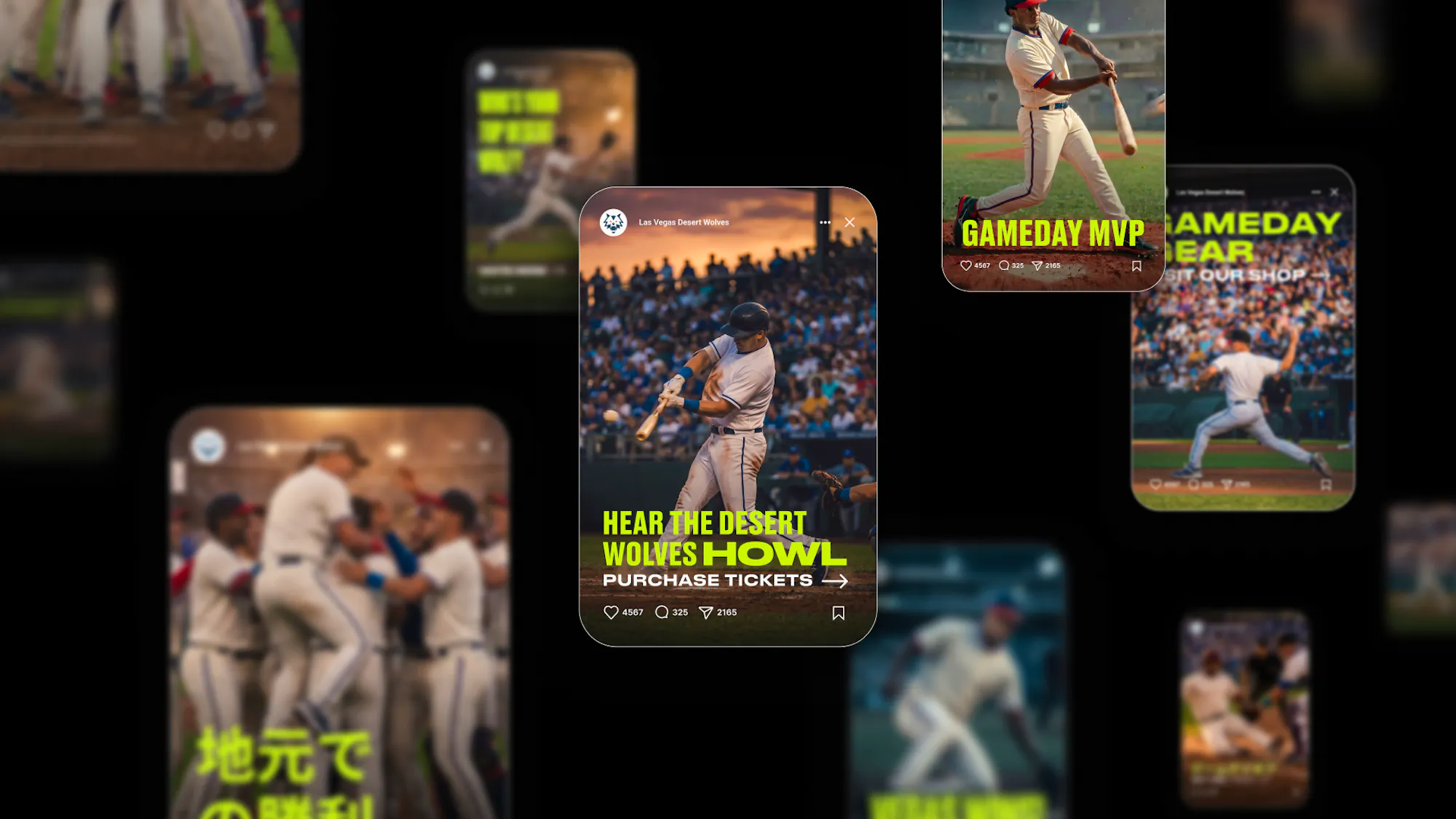
A typical major-league club manages around 80 to 150 sponsor partners. Each of those relationships carries contractual content deliverables: posts, campaigns, activations, event coverage, platform-specific formats across a multi-year calendar. That same organization is publishing across 13 or more owned channels to fan segments with different identities, different histories with the club and different commercial value. Season-ticket holders approaching renewal need different content than lapsed fans a club is trying to re-engage. Casual fans need different content than the high-value cohort teams want to move into premium tiers.The creative teams responsible for producing all of this content are usually comprised of just four to 10 people. Teams publish on X/Twitter at roughly 13 times the cross-industry average posting cadence.¹ The math has never worked.
What happens in practice is triage. The top tier of the sponsor portfolio gets resourced. The long tail, 60 or more partners who collectively represent meaningful renewal risk, routinely receive late, generic or missing deliverables. Fan segments get broadcast content rather than content built specifically for them. Every fan gets the same post regardless of who they are, and the commercial value of the audience stays on the table. Game-day reactive, where the most commercially valuable fan storytelling lives, operates as a crisis exercise instead of an operational capability. This is not a staffing failure. Headcount requests for creative teams rarely get approved at the scale the obligation requires, and the organizations that have tried already know it.

Governance vs. Speed
Every piece of content a sports organization produces carries rights complexity that most industries never encounter. Player likenesses, territorial restrictions, sponsor exclusion clauses, time-window rights, league-level brand standards and team-level approvals all have to be checked before anything is published. For fan-facing content, the complexity compounds: NIL obligations, athlete-tier content rights and the intersection of league brand standards with market-level localization for international fanbases that are growing faster than the system designed to serve them.That complexity lives in contracts, addenda and institutional knowledge distributed across legal, commercial and creative teams. The result is a compliance process built on sequential human review. Under normal timelines, it slows production. Under deadline pressure, it gets compressed or skipped, and rights violations or off-brand content make it to publication. The organizations managing this well have experienced people who carry the rules in their heads. That knowledge doesn’t transfer when those people leave, and the organizations that have experienced that turnover understand exactly how fragile the system is.
The organizations managing rights compliance well do it with people who carry the rules in their heads. That knowledge doesn’t transfer.

Intelligence vs. Execution
Every content cycle in sports starts from close to zero. What worked last season for which fan segment on which platform for which sponsor objective rarely gets captured in a system that informs the next cycle. Performance data exists in analytics platforms but doesn’t connect back to planning. Sponsor goals are discussed in kickoff meetings but left out of the briefs driving production. Fan-identity data sits in ticketing systems, app behavior logs, merchandise purchase histories and email engagement records, and almost none of it informs what gets made for those fans. Institutional knowledge resets with personnel changes, agency rotation and seasonal turnover.The downstream consequence shows up in the sponsor and the fan relationship. Only 5% of brands feel confident their sponsorship spend is reaching the right audience with the right assets, according to the World Federation of Advertisers’ Evolution of Sponsorship report.² Rights holders and sponsors don’t even agree on what success looks like. Properties rank attendance numbers and on-site interactions as their top proof points, while sponsors cite those same metrics at roughly half the rate.³ The measurement gap and the delivery gap are the same.
On the fan side, high-value cohorts receive the same broadcast content as everyone else because segment intelligence that should inform what gets made for them doesn’t survive the operational gaps between knowing who the fans are and producing content for them at scale.
The commercial impact can be measured from both directions. Seventy-four percent of brands cut their sponsorship portfolios in 2024, consolidating spend among partners that demonstrate delivery capability and activation impact.⁴ At the same time, fan-driven revenue streams are the business’s growth layer, and the operating entities that can activate identity-level fan data capture commercial upside that organizations running on broadcast operating system can’t reach.
74% of brands cut their sponsorship portfolios in 2024. At the same time, fan-driven revenue is the growth layer, and the organizations activating identity-level fan data capture upside others can’t reach.
Sports organizations know this. The CMOs and CCOs at the helm aren’t confused about the gap. They’re running a media company they were not built to operate, serving fans who expect a direct, personalized relationship with the club, while managing sponsor portfolios that require proof of delivery at a scale their teams were never sized to support. Although the ambition is there, the operating model isn’t.

Crafting a Modern Solution — The Content Operating System for Sports
What’s been outlined is a tangible gap, which is essentially a systems problem. Now, it has a systems solution. The Content Operating System for Sports brings Adobe's AI content supply chain technology together with the workflow design, governance architecture and integration expertise that sports teams and leagues require. Configured by Code and Theory, the Content Operating System for Sports was crafted to deliver measurable impact that are specific to the realities of a sports organization: the volume, the rights complexity, the channel fragmentation, the sponsor portfolio management. It doesn't abstract those realities away. It's built around them.
What sports organizations need isn't more headcount or better individual tools — it's an operation that connects the content supply chain end to end: rights-aware from brief to approval, fan-identity data informing what gets made rather than sitting in a separate system, sponsor obligations tracked against delivery in real time rather than reconciled at renewal. The operation has to be rebuilt around the media company it already is.
That's what Code and Theory and Adobe have been working toward. Read more about the solution in Adweek.
Arjun Kalyanpur, Head of Product
Source
- Rival IQ, 2024 Top Sports Teams on Social Media. Cadence measured on X/Twitter.
- WFA/Lumency, Evolution of Sponsorship.
- Sponsorship Marketing Association, 2023 Sponsorship Leaders Study.
- IEG/Lumency, Global Sponsorship Trends, 2025.